The Aggregate Root Pattern: Your Business Rules Deserve a Gatekeeper
Most developers scatter business rules across controllers, services, and repositories. The Aggregate Root pattern fixes that by creating a single, trusted entry point for all changes.
Most developers understand database relationships.
But many struggle with a more important question:
👉 Who is responsible for protecting your business rules?
That's exactly the problem the Aggregate Root Pattern solves.
Let me explain with a real example.
Imagine you're building an e-commerce system.
You have:
OrderOrderItemCustomerPayment
An Order can contain multiple Order Items.
Now suppose your business has these rules:
❌ An order cannot contain duplicate products.
❌ A shipped order cannot be modified.
❌ The total amount must always equal the sum of all order items.
Where should these rules live?
In many applications, they get scattered across:
- Controllers
- Services
- Repositories
- Database constraints
At first, everything works fine.
But as the system grows, the rules become harder to find, harder to enforce, and dangerously easy to bypass.
This is where the Aggregate Root comes in.
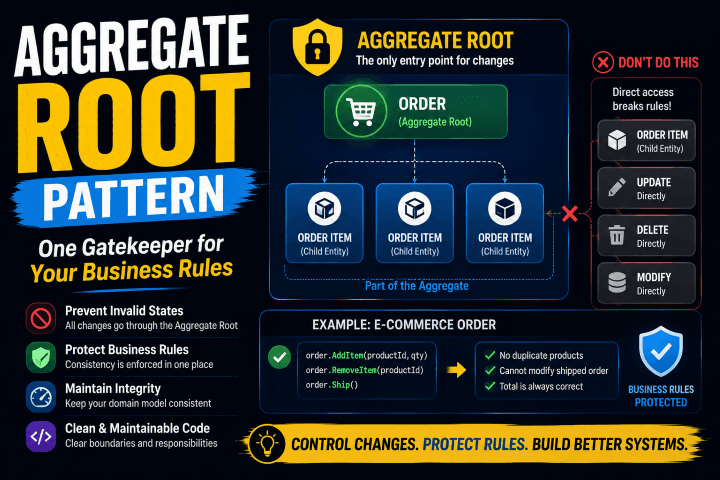
💡 Think of an Aggregate Root as the "gatekeeper" of a cluster of related objects.
In our example:
Order (Aggregate Root)
│
├── OrderItem
├── OrderItem
└── OrderItem
The Order is the Aggregate Root.
Nobody should directly modify an OrderItem.
All changes must go through the Order.
order.AddItem(productId, quantity);

order.RemoveItem(productId);

order.Ship();
Before adding an item, the Order checks:
✅ Is the order already shipped?
✅ Does this product already exist in the order?
✅ Is the quantity valid?
This keeps your business rules in one place — and consistently enforced.
A real-world analogy:
Think of a bank account.
You don't directly edit the balance field.
You don't write:
account.Balance += 1000;
Instead, you call an action:
account.Deposit(1000);
The account decides whether the operation is allowed.
That's exactly how an Aggregate Root works.
It protects the integrity of your business logic.
One mistake I see all the time:
Developers create Aggregate Roots but still let external code directly modify child entities.
At that point, the Aggregate Root is just a label.
It means nothing.
The entire purpose is to create a single, trusted entry point for every state change.
My takeaway:
An Aggregate Root isn't about object-oriented design.
It's about making sure your business rules can't be accidentally broken.
And as your system grows, that protection becomes invaluable.
Have you used Aggregate Roots in a real project?
Or do you prefer keeping things simpler for most applications?
Share this article

Dabananda Mitra
Software Engineer specializing in scalable backend systems and minimal, effective API design.
Comments
Loading comments...
More Writings
From Confusion to Clarity: How Large Software Systems Use Multiple Programming Languages and Frameworks
A personal learning journey about understanding how enterprise software is built using multiple programming languages, frameworks, APIs, and microservices.
Read Article →Design PatternsCQRS: It's Not About Complexity. It's About Clarity
CQRS gets a bad reputation for overengineering. But at its core, it's a simple idea — reads and writes are fundamentally different, so treat them differently.
Read Article →WindowsHow to Kill a Process Using Port in Windows: Complete Guide
Learn how to find and kill a process using a specific port in Windows with netstat, tasklist, and taskkill commands. A practical guide for .NET and ASP.NET Core developers.
Read Article →