CQRS: It's Not About Complexity. It's About Clarity
CQRS gets a bad reputation for overengineering. But at its core, it's a simple idea — reads and writes are fundamentally different, so treat them differently.
I spent a long time thinking CQRS was only for massive enterprise systems.
Turns out, I was looking at it the wrong way.
💡 CQRS isn't about making your architecture more complex.
It's about making your intentions clearer.
Let me start with a simple analogy.
Imagine you're running a restaurant.
Customers do two very different things:
1️⃣ They view the menu.
2️⃣ They place an order.
Now imagine routing both of those through the exact same process.
Want to see the menu? Go through the ordering system.
Want to place an order? Same system.
Sounds absurd, right?
Yet that's how most applications are built.
The same model, the same service, the same class handles both:
- Reading data
- Writing data
This is where CQRS comes in.
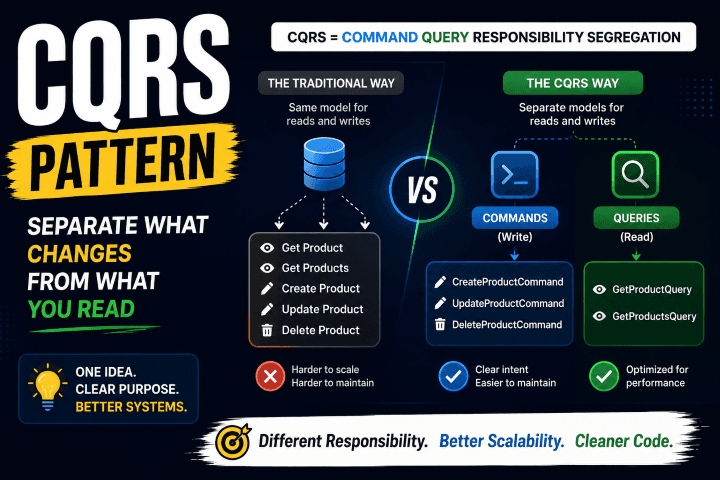
CQRS = Command Query Responsibility Segregation
The idea is simple:
🔹 Commands change data.
🔹 Queries read data.
And they're handled separately.
Before CQRS, a typical service looks like this:
ProductService
├── GetProduct()
├── GetProducts()
├── CreateProduct()
├── UpdateProduct()
└── DeleteProduct()
After applying CQRS, you split responsibilities:
Commands
├── CreateProductCommand
├── UpdateProductCommand
└── DeleteProductCommand

Queries
├── GetProductQuery
└── GetProductsQuery
Now every class has one clear purpose.
When another developer opens the code, they immediately know:
"Is this reading data or changing it?"
No guessing. No digging through a 500-line service class.
What I like most about CQRS is how naturally it scales.
As a project grows, write-side logic gets more complex — validations, domain events, business rules.
Read-side logic needs different optimizations — projections, caching, denormalized views.
Keeping them separated lets each side evolve independently.
But here's the mistake I see over and over:
🚨 Not every project needs CQRS.
Developers hear about CQRS and immediately introduce dozens of handlers, pipelines, and abstractions into a simple CRUD app.
That's like buying a Formula 1 car to drive to the grocery store.
Architecture should solve problems, not create them.
My rule:
👉 If your application is simple, keep it simple.
👉 If your reads and writes are pulling in different directions, CQRS will feel like a relief.
The best architecture isn't the most sophisticated one.
It's the one your team can understand, maintain, and grow with confidence.
Have you used CQRS in a production application?
Did it simplify your codebase — or just add noise?
Share this article

Dabananda Mitra
Software Engineer specializing in scalable backend systems and minimal, effective API design.
Comments
Loading comments...
More Writings
From Confusion to Clarity: How Large Software Systems Use Multiple Programming Languages and Frameworks
A personal learning journey about understanding how enterprise software is built using multiple programming languages, frameworks, APIs, and microservices.
Read Article →Design PatternsThe Aggregate Root Pattern: Your Business Rules Deserve a Gatekeeper
Most developers scatter business rules across controllers, services, and repositories. The Aggregate Root pattern fixes that by creating a single, trusted entry point for all changes.
Read Article →WindowsHow to Kill a Process Using Port in Windows: Complete Guide
Learn how to find and kill a process using a specific port in Windows with netstat, tasklist, and taskkill commands. A practical guide for .NET and ASP.NET Core developers.
Read Article →