From Confusion to Clarity: How Large Software Systems Use Multiple Programming Languages and Frameworks
A personal learning journey about understanding how enterprise software is built using multiple programming languages, frameworks, APIs, and microservices.
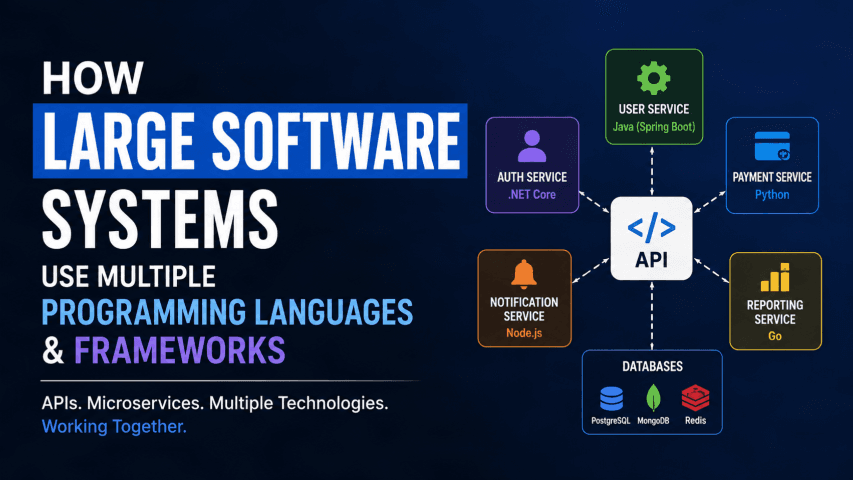
When I first started learning programming, I built small projects like calculators, CRUD applications, and simple login systems. At that time, one question constantly came to my mind:
How are large software systems built using multiple programming languages and frameworks?
I used to think everything existed inside one massive project. As I gained more experience through learning and working on real-world applications, I realized that the reality is very different.
Enterprise Software Isn't One Big Project
Most enterprise applications are not a single project. Instead, they are a collection of independent applications or services, where each service is responsible for a specific task.
For example, in a banking system, there might be separate services for:
- Authentication
- Customer Management
- Transactions
- Notifications
- Reporting
This separation makes the system easier to develop, test, deploy, and maintain.
Communication Happens Through APIs
These services don't directly access each other's code or databases. Instead, they communicate through technologies such as:
- REST APIs
- gRPC
- Message Queues
- Event-Driven Communication
This approach allows each service to evolve independently without affecting the entire system.
Why Multiple Programming Languages?
Another thing that surprised me was seeing different programming languages inside the same system.
Now it makes perfect sense.
Every language and framework has its own strengths.
For example:
- ASP.NET Core for business APIs
- Java Spring Boot for enterprise services
- Python for machine learning or data processing
- React or Angular for frontend applications
- Redis for high-speed caching
The important thing isn't that every service uses the same language. The important thing is that they can communicate reliably through well-designed APIs.
One Database Isn't Always Enough
The same principle applies to databases.
A real-world application might use:
- SQL Server
- Oracle
- PostgreSQL
- MongoDB
- Redis
Each database is selected because it fits a particular requirement, not because the team wants to use only one technology everywhere.
What I Learned
Working on enterprise software changed how I think about programming.
I used to believe becoming a better developer meant learning more programming languages.
Now I realize the bigger picture is understanding:
- Software Architecture
- API Design
- Scalability
- Security
- Maintainability
Writing code is only one part of software engineering. Designing systems that work together efficiently is equally important.
Final Thoughts
Looking back, I smile at the question that once confused me so much.
The answer didn't come from a single tutorial or book. It came from building projects, making mistakes, and working on real applications.
If you're currently building small projects, don't underestimate them.
Every small project teaches you something new, and those lessons eventually become the foundation for understanding large-scale software systems.
Learning programming isn't just about mastering a language.
It's about learning how to solve problems, divide complex systems into manageable components, and connect those components to build something meaningful.
That's what makes software engineering such an exciting journey.
Thanks for reading.
If you've ever had a programming question that seemed impossible at first but became clear with experience, I'd love to hear your story.
Share this article

Dabananda Mitra
Software Engineer specializing in scalable backend systems and minimal, effective API design.
Comments
Loading comments...
More Writings
The Aggregate Root Pattern: Your Business Rules Deserve a Gatekeeper
Most developers scatter business rules across controllers, services, and repositories. The Aggregate Root pattern fixes that by creating a single, trusted entry point for all changes.
Read Article →Design PatternsCQRS: It's Not About Complexity. It's About Clarity
CQRS gets a bad reputation for overengineering. But at its core, it's a simple idea — reads and writes are fundamentally different, so treat them differently.
Read Article →WindowsHow to Kill a Process Using Port in Windows: Complete Guide
Learn how to find and kill a process using a specific port in Windows with netstat, tasklist, and taskkill commands. A practical guide for .NET and ASP.NET Core developers.
Read Article →