Clean Code Chapter 1: The Lesson That Changed How I Think About Writing Software
After reading Chapter 1 of Clean Code by Robert C. Martin, I realized that writing code isn't just about making it work. It's about making it readable, maintainable, and easy for future developers—including yourself—to understand.
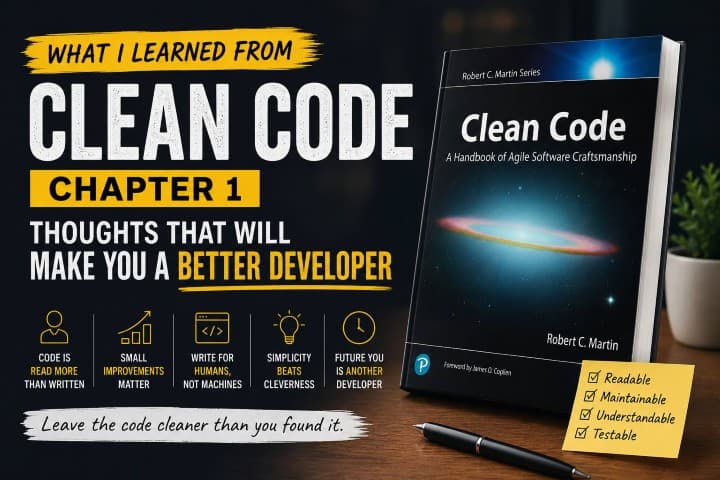
Clean Code Chapter 1: The Lesson That Changed How I Think About Writing Software
Recently, I finished reading Chapter 1 of Clean Code by Robert C. Martin.
Even though it's the first chapter, it significantly changed the way I think about writing software.
One lesson stood out more than anything else:
"We write code once, but we read it hundreds of times."
At first, this sounds obvious.
But when I thought about my daily work as a software engineer, I realized how true it is.
Most of my time isn't spent writing new code.
Instead, I'm:
- Reading existing code
- Debugging issues
- Understanding business logic
- Reviewing pull requests
- Extending existing features
- Fixing production bugs
In other words, software development is often more about reading code than writing it.
The Trap Many Developers Fall Into
When we're learning programming, the primary goal is usually simple:
Make the code work.
And that's fine in the beginning.
But as applications grow, something interesting happens.
The biggest challenge is no longer getting the computer to understand your code.
The biggest challenge is helping other developers understand it.
Sometimes that developer is your teammate.
Sometimes it's a future developer who joins the project.
And sometimes it's you six months later.
My Key Takeaways from Chapter 1
1. Code Should Be Written for Humans First
Computers don't care if your variable name is meaningful.
Humans do.
This:
int d;
works perfectly.
But this:
int daysSinceLastLogin;
communicates intent.
The second version makes the code easier to understand without requiring additional explanation.
2. Dirty Code Creates Long-Term Costs
Many developers have experienced this.
You're under pressure.
You take a shortcut.
You skip refactoring.
You leave a TODO comment.
The feature gets delivered quickly.
Problem solved.
Or so it seems.
A few months later, someone needs to modify that code.
Now they spend hours trying to understand it.
The shortcut that saved 10 minutes yesterday may cost several hours in the future.
3. Leave the Code Better Than You Found It
One principle from the chapter that I really liked is often called:
The Boy Scout Rule
"Leave the campground cleaner than you found it."
Applied to software development, it means:
- Improve a variable name
- Remove dead code
- Simplify a method
- Add missing tests
You don't need to rewrite the entire system.
Small improvements made consistently create a cleaner codebase over time.
4. Readability Is More Important Than Cleverness
Sometimes developers write code that feels smart.
Complex one-liners.
Nested conditions.
Advanced language tricks.
The problem?
Future developers have to understand it.
Clean code favors clarity over cleverness.
The best code often isn't the most impressive.
It's the easiest to understand.
5. Write Code for Future You
One day you'll return to code you wrote months ago.
When that happens, you want your code to explain itself.
Good naming.
Clear structure.
Small methods.
Meaningful abstractions.
These aren't just best practices.
They're investments in your future productivity.
My Biggest Lesson
Before reading this chapter, I mostly thought about whether code worked.
Now I'm thinking more about whether code communicates.
Because software development isn't just about solving problems.
It's about solving problems in a way that other people can understand, maintain, and improve.
That's what makes code truly valuable.
Final Thoughts
Chapter 1 reminded me that writing clean code is not just a technical skill.
It's a professional responsibility.
Every line of code becomes part of a system that someone else will eventually read.
The easier we make that job, the more effective we become as engineers.
I'm looking forward to reading the remaining chapters and applying these lessons in my daily work.
I'll also be sharing my key takeaways from each chapter as I continue the journey.
What About You?
Have you read Clean Code?
What lesson from the book had the biggest impact on the way you write software?
Share this article

Dabananda Mitra
Software Engineer specializing in scalable backend systems and minimal, effective API design.
Comments
Loading comments...
More Writings
Clean Code Chapter 4: Comments Are Not a Substitute for Clean Code
My key learnings from Chapter 4 of Clean Code by Robert C. Martin. This chapter changed how I think about comments and taught me why writing self-explanatory code is often better than explaining code with comments.
Read Article →BooksClean Code Chapter 2: Why Naming Is One of the Hardest Parts of Programming
My key learnings from Chapter 2 of Clean Code by Robert C. Martin. This chapter taught me that good names can make code self-explanatory, while poor names can make even simple code difficult to understand.
Read Article →BooksClean Code Chapter 3: Functions Should Do One Thing, and Do It Well
My key learnings from Chapter 3 of Clean Code by Robert C. Martin. This chapter taught me that small, focused functions are easier to read, test, maintain, and understand than large functions that try to do everything.
Read Article →