Redis Caching: The Architectural Change That Beats a Hundred Code Optimizations
A junior engineer's first real encounter with Redis caching — and why sometimes the biggest performance win isn't smarter code, it's less work.
A few months ago, my mentor gave me a deceptively simple task:
"Learn Redis caching."
My first reaction?
"Okay, just another technology to tick off the list."
Then I got the chance to implement it in our production system.
That's when I understood why caching is such a big deal.
💡 Our project handles millions of requests.
Before Redis, every request had to travel all the way to the database — even when asking for the exact same data that was just fetched a millisecond ago.
The database handled it.
But it was unnecessary work, repeated endlessly.
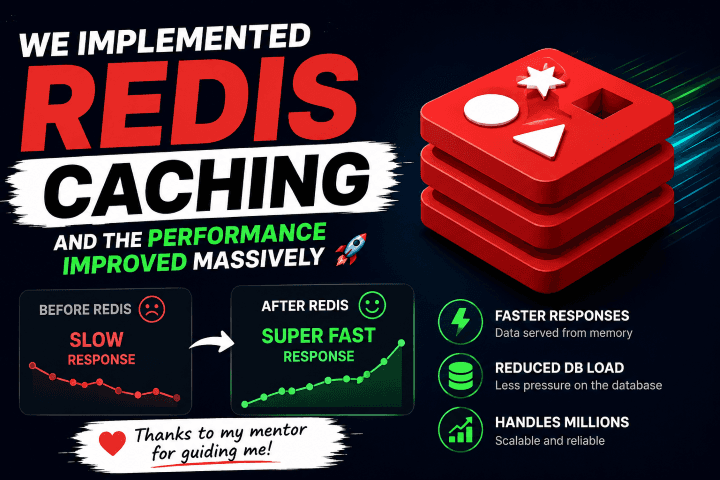
Then we introduced Redis.
Instead of hitting the database every time, frequently accessed data is served directly from memory.
The result?
⚡ Faster response times
⚡ Significantly reduced database load
⚡ Better scalability under traffic spikes
⚡ A noticeably smoother user experience
The concept itself is surprisingly simple.
Imagine you visit a library every day and ask for the same book.
Without caching, the librarian walks through the shelves every single time to find it.
With caching, the librarian keeps the book on the desk — because they know people ask for it constantly.
That's essentially what Redis does.
It stores frequently accessed data in memory so your application can retrieve it almost instantly, without touching the database.
In .NET, wiring it up looks something like this:
// Store in cache
await _cache.SetStringAsync(
    key: $"product:{productId}",
    value: JsonSerializer.Serialize(product),
    options: new DistributedCacheEntryOptions
    {
        AbsoluteExpirationRelativeToNow = TimeSpan.FromMinutes(10)
    }
);

// Read from cache
var cached = await _cache.GetStringAsync($"product:{productId}");

if (cached is not null)
    return JsonSerializer.Deserialize<Product>(cached);

// Fallback to database
var product = await _repository.GetByIdAsync(productId);
✅ Cache hit → data returned in microseconds.
✅ Cache miss → database is called, result is cached for next time.
One thing this experience taught me as a junior engineer:
Performance optimization isn't always about writing smarter algorithms.
Sometimes the biggest gain comes from simply reducing unnecessary work.
One small architectural change can outperform hundreds of lines of refactored code.
One mistake teams make with caching:
🚨 Caching everything without thinking about invalidation.
Stale data is worse than slow data.
Always have a clear strategy for when your cache expires or gets invalidated — especially for data that changes frequently.
My takeaway:
Caching is not a trick. It's an architectural decision.
And like all architectural decisions, it comes with tradeoffs you need to understand before you apply it blindly.
What technology have you learned recently that completely changed how you think about building software?
Share this article

Dabananda Mitra
Software Engineer specializing in scalable backend systems and minimal, effective API design.
Comments
Loading comments...
More Writings
How to Run Oracle Database XE on Docker and Connect with PL/SQL Developer on Windows
A complete step-by-step guide to running Oracle Database XE in Docker and connecting it with PL/SQL Developer on Windows 11.
Read Article →WindowsHow to Kill a Process Using Port in Windows: Complete Guide
Learn how to find and kill a process using a specific port in Windows with netstat, tasklist, and taskkill commands. A practical guide for .NET and ASP.NET Core developers.
Read Article →.NETTop 500 .NET Interview Questions | Complete Preparation Guide
Preparing for a .NET developer interview? I collected 500 unique interview questions covering the most important areas of the .NET ecosystem. This is a useful revision resource for freshers and experienced .NET developers preparing for technical interviews. Save it, practice the questions category by category, and use it as a structured roadmap for your .NET interview preparation.
Read Article →