The Modular Monolith: The Architecture Most Teams Should Start With
Everyone talks about monoliths vs microservices. But there's a third option that gives you the best of both — and most developers overlook it entirely.
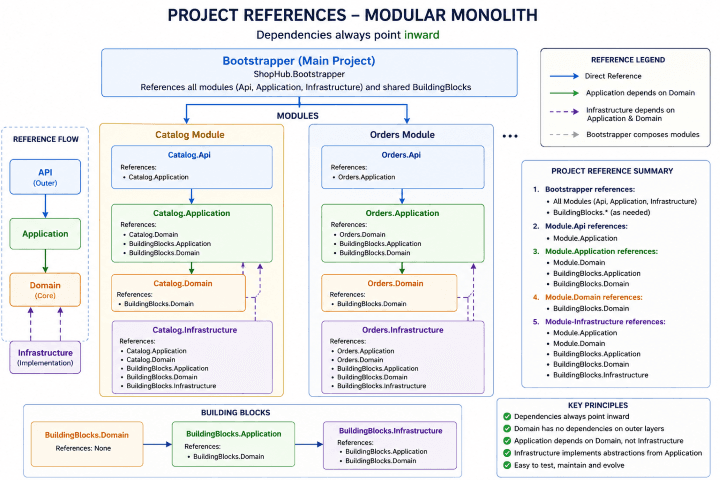
Most developers think there are only two choices in software architecture:
➡️ Build a Monolith
➡️ Build Microservices
But there's a third option that many successful companies use before ever touching microservices:
The Modular Monolith.
And honestly, it's one of the most underrated architectural patterns in software engineering.
A few months ago, I thought a modular monolith was just a monolith with better folder names.
I was wrong.
Here's the difference.
A traditional monolith is like putting your entire house into one giant room.
Kitchen, bedroom, office, and dining room — all in one open space.
Everything can reach everything.
It's fast to set up.
But as more people move in and the house gets bigger, it turns into chaos.
A change in the kitchen accidentally breaks the bedroom.
Nobody knows who owns what.
Finding anything becomes an excavation project.
A Modular Monolith is different.
Think of it as a house with separate, well-defined rooms.
Each room has a clear purpose.
Each room has its own walls and a door.
You enter through the door — you don't knock down the wall.
In software terms, for an e-commerce application:
Solution
├── Modules
│   ├── Inventory
│   │   ├── Controllers
│   │   ├── Services
│   │   ├── Domain
│   │   └── Data
│   ├── Orders
│   │   ├── Controllers
│   │   ├── Services
│   │   ├── Domain
│   │   └── Data
│   ├── Payments
│   └── Users
└── Shared
    └── Contracts (interfaces between modules)
Each module owns its:
✅ Controllers
✅ Business logic
✅ Domain models
✅ Database access
Other modules cannot reach inside.
They communicate through well-defined interfaces — not by directly referencing each other's internals.
This gives you most of the benefits of microservices without the operational headache.
Why teams prefer Modular Monoliths over microservices when starting out:
✅ Single codebase — no distributed systems complexity
✅ Easier deployment — one thing to ship
✅ Easier debugging — no network calls between services to trace
✅ Strong separation of concerns — teams own their modules
✅ Faster development — no service contracts to negotiate upfront
✅ Much lower infrastructure cost
✅ Clear migration path to microservices if you ever need it
One mistake I see constantly:
Developers create folders called Modules but let every module freely import from every other module.
// ❌ This defeats the entire purpose
using EcommerceApp.Modules.Orders.Data;  // from inside Payments module
That's not a modular architecture.
That's a monolith with a better directory tree.
The real value of a Modular Monolith comes from enforcing the boundaries.
If a module can access another module's internals freely, you don't have modules.
You have organized chaos.
My rule:
👉 Modules communicate through interfaces, not implementations.
👉 If you're tempted to reference another module's DbContext directly, stop — that's a design smell.
For most startups and growing applications, a well-designed Modular Monolith is a far better starting point than jumping straight to microservices.
Microservices solve problems of scale and team independence.
If you don't have those problems yet, you're just creating complexity you don't need.
Have you worked on a Modular Monolith before?
What was the hardest boundary to enforce in your team?
Share this article

Dabananda Mitra
Software Engineer specializing in scalable backend systems and minimal, effective API design.
Comments
Loading comments...
More Writings
How to Kill a Process Using Port in Windows: Complete Guide
Learn how to find and kill a process using a specific port in Windows with netstat, tasklist, and taskkill commands. A practical guide for .NET and ASP.NET Core developers.
Read Article →.NETTop 500 .NET Interview Questions | Complete Preparation Guide
Preparing for a .NET developer interview? I collected 500 unique interview questions covering the most important areas of the .NET ecosystem. This is a useful revision resource for freshers and experienced .NET developers preparing for technical interviews. Save it, practice the questions category by category, and use it as a structured roadmap for your .NET interview preparation.
Read Article →.NETProject Template: ASP.NET Core Web Api Modular Monolith
Tired of doing the starting configuration again and again for new projects? Here is the solution. Use this Modular Monolith ASP.NET Core Web Api starting template and directly jump into main code.
Read Article →